
A payment fight on a Virginia building project can become a property question quickly. A contractor may be waiting for payment on an invoice. An owner may open the mail and find a recorded lien. A supplier may hear that the general contractor was paid, while their own bill is still open. A Virginia mechanic’s lien lawyer can help you sort which facts matter. Some deadlines will not wait for a calmer week.
Call (757) 913-5204 to schedule a No Hassle Legal Strategy Meeting
This is general information about Virginia mechanic’s liens. It is not advice about your project, contract, or a recorded claim. Holcomb Law, P.C. meets with people and businesses in Newport News, Yorktown, Hampton, Virginia Beach, and Lynchburg when a civil or business dispute needs a next step. Virginia dispute counsel can also help you compare a settlement talk with a court case. The meeting is informational. It is not a sales pitch, and it does not promise how a lien claim will end.
What a Virginia mechanic’s lien actually is
A mechanic’s lien is a property claim for certain labor or materials. The work has to build, repair, remove, or improve a building or structure attached to the land. Virginia’s starting rule is in Code of Virginia section 43-3. It covers labor or materials worth $150 or more, including reasonable equipment rental, if the lien is perfected as the Code requires.
That last clause does most of the work. Doing the job does not, by itself, put a lien on the property. The claimant has to follow the filing and notice steps in Title 43. Miss those steps and the claim may stay an ordinary payment dispute. Contract options may remain. The property claim may not.
The same statute draws a line for repair work. For repairs or improvements to an existing structure, the lien does not attach unless the owner or the owner’s agent ordered or authorized the work. A subcontractor hired only by another contractor should not assume the mailbox name is enough. The contract chain matters.
Title 43 also has special rules for condominiums and common elements. One contract can cover more than one unit. The lien may then be split among those units. A unit owner may have a path to a release after paying that unit’s share. A past-due invoice alone will not show this.
Which payment or property disputes raise the question
Not every unpaid invoice is a mechanic’s lien. The question comes up when unpaid work is tied to a building or structure. Someone then wants the property itself to stand behind the debt. People usually bring these situations to a first meeting.
- A general contractor finished work, or stopped work, and the owner has not paid the contract balance.
- A subcontractor or supplier was not paid by the party that hired them, even though the owner may have paid someone else.
- An owner, buyer, or lender finds a recorded memorandum and needs to know what it claims and how it can be challenged.
- A repair or improvement was done on an existing building, and it is unclear whether the owner authorized it.
- A project changed hands, a draw was held back, or a lien waiver was signed and the parties disagree about what it covered.
A defect in the work is a different question. A leak, a crack, or a weak system may matter to payment. It does not by itself decide who can file a lien, or whether a lien was perfected. Holcomb’s guide to a Virginia construction defect lawsuit covers workmanship, cause, and responsibility.
A general business fight is different when no labor or materials went into a structure. A membership deadlock, a service contract, or a boundary dispute may still need counsel. It is not a mechanic’s lien just because money and property are both involved.
What the memorandum has to show
For a general contractor, perfection starts with a memorandum of lien. It is filed in the clerk’s office where the building, structure, or railroad is located. Section 43-4 lists what that memorandum must show. It needs the owner and the claimant, with addresses. It also needs the amount and the consideration. List when the sum is due and the interest date. Add a short property description. The claimant must verify that they intend to claim the lien.
A Board for Contractors license or certificate has to be listed too, if the claimant has one. Include the number and the issue and expiration dates. A general contractor must also certify that a copy was mailed to the owner at the last known address. Some other claimants do not have that same mailing step.
One memorandum cannot reach back forever. It may not include labor or materials furnished more than 150 days before the last day of that work. A claimant may file more than one memorandum. Sort a thick invoice history by date before you assume one filing covers the whole job.
Recording and indexing matter. From that point, other people are treated as having notice of the claim. An owner who never saw the paperwork should not assume a buyer or lender will miss it. A filing in the wrong clerk’s office is a different problem. So is a wrong property description. Check those facts against the land records, not against memory.
When should you call a Virginia mechanic’s lien lawyer?
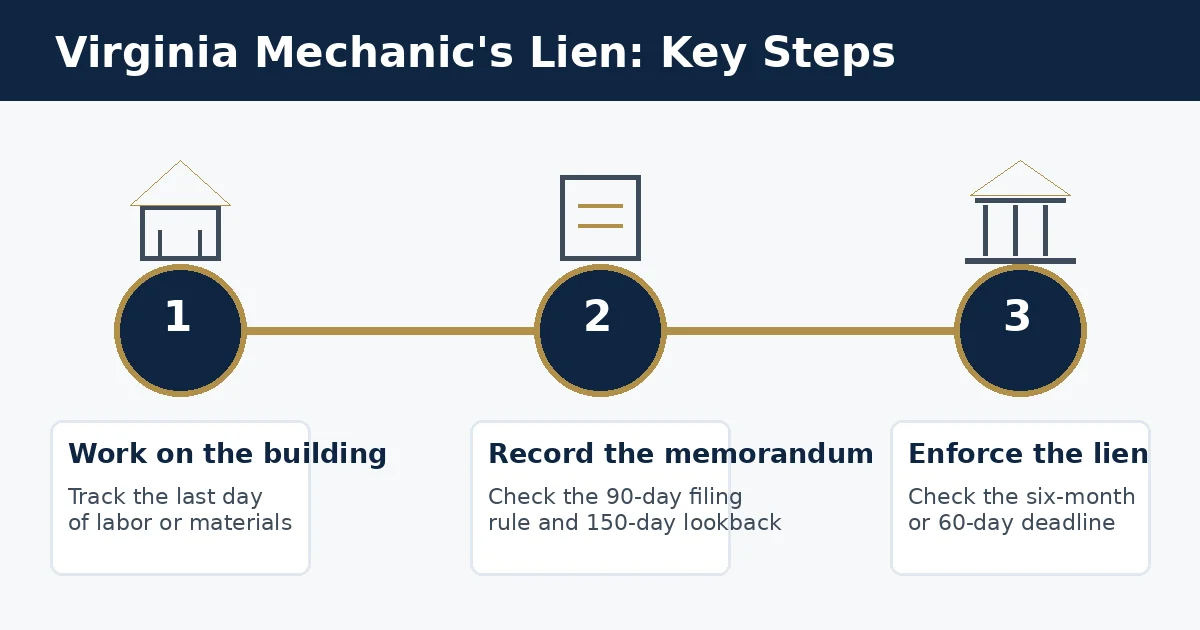
Virginia’s mechanic’s lien deadlines are short, and they do not all measure from the same event. Two of them decide whether there is a lien to talk about at all.

| Question | Virginia rule to ask about | Why it matters |
|---|---|---|
| When must the memorandum be filed? | Within 90 days after the last day of the month of the last labor or materials. Also within 90 days after the work is completed or terminated. | A late memorandum can leave the claimant with a payment claim and no perfected lien |
| How far back can one memorandum reach? | Charges older than 150 days before the last day of that work stay out of that memorandum. | Older invoices may need their own memorandum, if a filing window is still open |
| When must a suit to enforce the lien be filed? | Six months after the memorandum is recorded, or 60 days after the work ends, whichever is later. | A recorded lien can still expire if no one enforces it on time. |
The enforcement limit is in section 43-17. It applies to liens perfected under the sections it names. Filing a proper petition to enforce the lien counts as bringing the suit. Nothing in that section extends the time to perfect the lien. Recording the memorandum and suing on it are separate acts.
Other Virginia lawsuits use different clocks. For an ordinary civil claim, read the firm’s guide to the Virginia civil lawsuit statute of limitations. Do not borrow a number from this table. A contract claim and a mechanic’s lien can come from the same project and still run on different timelines.
Subcontractors and suppliers can have extra notice rules. Do not copy a general contractor’s calendar onto a lower-tier claim. Bring the contract, the last invoice, the last day on site, and any notice already sent.
What an owner should do after a lien is recorded
If you own the property, a recorded lien is not a judgment. It is also not proof that the amount is correct. It is still serious. It can cloud a sale or a refinance. The claimant may have a short window to sue. Waiting to see if they “really mean it” can use up the time you needed to respond.
Start with the paper, not the argument. Get the recorded memorandum, the legal description, the amount, and the recording date. Then collect the contract, change orders, draw schedules, proof of payment, and any lien waiver. Proof that you paid a general contractor is useful. It may not answer a claim by someone that contractor hired.
Ask a lawyer to compare the memorandum with the statute before you pay to make it go away. The property description, the owner name, the license details, the mailing certification, and the dates of work are all places a filing can fail. Paying the full claimed amount is sometimes the practical choice. It is not the only choice, and it should not be the first one just because the document looks official.
Owners also ask if the claimant can be required to prove the debt sooner. They ask if a bond can stand in for the property. Those options depend on the Code and on the court. They are worth a specific conversation. Do not invent those steps from a blog post.
What a contractor or supplier should gather first
Claimants usually lose time looking for documents they already have. Before a meeting, put these items in one place:
- The contract, proposal, or purchase order, including who signed it and who the owner is.
- Invoices, delivery tickets, and a list of the last day labor was performed or material was furnished.
- Change orders, approved extras, and any written direction from the owner or the owner’s agent.
- Payments received, joint checks, and any lien waiver or partial release you signed.
- Your contractor license or certificate, if you have one, with the issue and expiration dates.
- The property address and, if you have it, the legal description or tax parcel.
Bring the bad facts too. A gap in the work, a disputed back charge, or a waiver that covers more than you remember will come out later. It is more useful at the start, when someone can still tell you whether a filing window is open.
If you are a subcontractor, also bring proof of who hired you and any notice you gave the owner or the general contractor. The right to a lien, and the steps to perfect it, are not identical at every tier of the project. A supplier who never set foot on the site can still have a claim. The paperwork has to show the materials and the structure they went into.
How a lien question connects to a larger dispute
A mechanic’s lien is one tool inside a payment dispute. It is not the whole case. People still choose whether to negotiate, mediate, file suit, or do more than one of those. Holcomb Law handles civil and business disputes. The firm also offers mediation through the Holcomb Mediation Center as an alternative to a courtroom fight. Counsel can talk through whether a recorded lien, a contract claim, or both belong in the plan.
Mediation is a structured settlement talk. Litigation asks a court to decide what the parties cannot resolve. A lien deadline can force a filing even while people are still willing to talk. That is a timing choice, not a sign that settlement is off the table. The mediation and litigation comparison explains how those paths differ. Bring the lien dates so the conversation stays tied to this project.
Some disputes are really about court process or cost. The firm’s overview of a civil litigation attorney covers that ground. This article stays on the lien. It covers who may claim one, what the memorandum must contain, and which clocks make delay expensive.
Holcomb’s offices are in Newport News, Virginia Beach, Hampton, and Lynchburg, and the firm also serves Yorktown. A Hampton Roads project and a Lynchburg project use the same Code. The memorandum is still filed in the clerk’s office where the property sits. The courthouse follows the building, not the office that printed the invoice.
Request a No Hassle Legal Strategy Meeting about your lien questions
Frequently asked questions
Use the questions below to get ready. They are not a checklist that replaces a review of your documents.
Does every unpaid construction bill create a mechanic’s lien?
No. Virginia gives a lien for certain labor and materials on a building or structure only if it is perfected under Title 43. Repair work on an existing structure also has to be ordered or authorized by the owner or the owner’s agent. An unpaid bill can still be a contract dispute without being a lien.
How fast does a general contractor have to file?
Section 43-4 uses a 90-day clock. It runs from the last day of the month of the last labor or materials. It also ends no later than 90 days after the work is completed or terminated. Count from the records, not from the day the argument started.
Does recording the lien finish the job?
No. A suit to enforce a perfected lien has its own limit under section 43-17. The case is due six months after recording, or 60 days after the work ends, whichever is later. Missing that deadline can end the lien remedy even after a timely filing.
Can an owner ignore a lien that looks wrong?
Ignoring it is risky. A flawed lien may be open to challenge. A recorded memorandum can still affect a sale or loan while it sits in the land records. Have the filing and your payment records read together before you pay, bond, or contest it.
Where should you start if you are unsure a lien even applies?
Start with the contract, the last date of work, and any recorded memorandum. Holcomb Law can use a No Hassle Legal Strategy Meeting to walk through those papers. You can then decide if you need a lawyer, and whom to hire. Call (757) 913-5204 or write through the firm’s contact page. Nothing here predicts a filing, a challenge, or a lawsuit.